
Innovation in Payment Systems
Bitcoin isn't just about sending money. It has many features and opens new possibilities that the community continues to build on. Here are some of the technologies in active use today, along with directions still being explored. The most interesting uses of Bitcoin may be the ones still ahead.

Control against fraud
Bitcoin gives users a high level of security for their money. The network protects against common types of fraud like chargebacks or unwanted charges, and bitcoins cannot be counterfeited. Users can back up or encrypt their wallets, and hardware wallets make funds very difficult to steal or lose. Bitcoin is designed to let its users hold complete control over their money.

Global accessibility
Bitcoin lets any business or individual send and receive money across borders, with or without a bank account, reaching regions still underserved by traditional payment systems. Combined with the Lightning Network, these transfers can settle within seconds, expanding global access to commerce and helping international trade to flourish.

Cost efficiency
With cryptography, secure payments are possible without slow and costly middlemen. On-chain fees vary with network demand, while Layer-2 networks like the Lightning Network enable fast, low-cost payments, often for a fraction of a cent. This makes Bitcoin practical for everyday transactions, not just large transfers. Bitcoin can also help reduce poverty by cutting the high fees charged on cross-border payments.

Tips and donations
Bitcoin is a particularly efficient way to send tips and donations. A payment takes only one click, and receiving donations can be as simple as displaying a QR code. Public donation addresses give non-profits added transparency, and in emergencies such as natural disasters, Bitcoin lets support cross borders quickly when it is needed most.

Crowdfunding
Bitcoin can power crowdfunding campaigns where individuals pledge money to a project, collected only if enough pledges meet the target. These assurance contracts are enforced by the Bitcoin protocol itself, which holds a transaction until every condition is met. Learn more about the technology behind crowdfunding.

Micro payments
Bitcoin makes it possible to send very small amounts of money efficiently. The Lightning Network, a Layer-2 network built on top of Bitcoin, settles these micropayments almost instantly and at near-zero cost. It already powers content tipping, streaming payments, and pay-per-use services. Learn more about the technology behind Bitcoin micropayments.

Dispute mediation
Bitcoin supports dispute mediation through multi-signature transactions. A mutually trusted third party can approve or reject a payment in case of disagreement, without ever holding custody of the funds. Because these escrow services work with any Bitcoin user or merchant, they open the door to open competition and higher standards for buyer and seller protection.

Multi-signature accounts
Multi-signature requires that a transaction be approved by several parties before the network accepts it. A group treasury can require multiple members to agree before funds move; families can secure savings or plan inheritance; and individuals can split their keys across devices so that losing one does not mean losing access. It is a foundation for shared custody and stronger personal security.

Trust and integrity
Bitcoin addresses many trust problems in finance. With selective transparency, digital contracts, and irreversible transactions, it offers a foundation for verifiable agreements. Because the network's rules are enforced by thousands of independent participants rather than any single institution, no party can quietly rewrite the ledger or cheat the system at others' expense.

Resilience and decentralization
Through decentralization, Bitcoin created a payment network with a high degree of resilience and redundancy. It secures a network worth over a trillion dollars without any central point of failure, such as a data center, which makes it extremely difficult to attack. Bitcoin is a meaningful step forward in securing local and global financial systems.

Flexible transparency
All Bitcoin transactions are public and transparent and the identity of the people behind transactions are private by default. This allows individuals and organizations to work with flexible transparency rules. For instance, a business can choose to reveal certain transactions and balances only to certain employees just like a non-profit organization is free to allow the public to see how much they receive in daily and monthly donations.

Automated solutions
Automated services often struggle with the costs and limitations of cash and card payments, from vending machines to parking meters. Bitcoin, especially over the Lightning Network, can power a new generation of automated services that settle payments directly between machines at low cost. Autonomous vehicles and checkout-free stores already exist, and Bitcoin offers them a native, programmable way to transact.
Self-custody and sovereignty
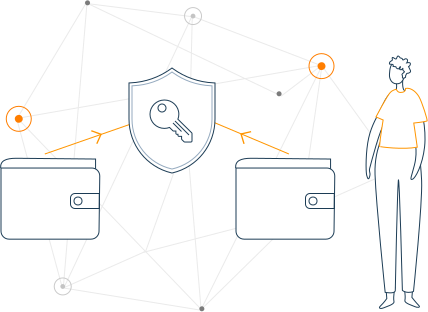
With Bitcoin, you can hold your own money directly, without relying on a bank or custodian. Your funds are controlled by private keys that only you hold, often secured on a hardware wallet. No intermediary controls your funds, and no institution can fail and take them with it. This freedom comes with responsibility: protecting your keys is essential, because with Bitcoin you are your own bank.